
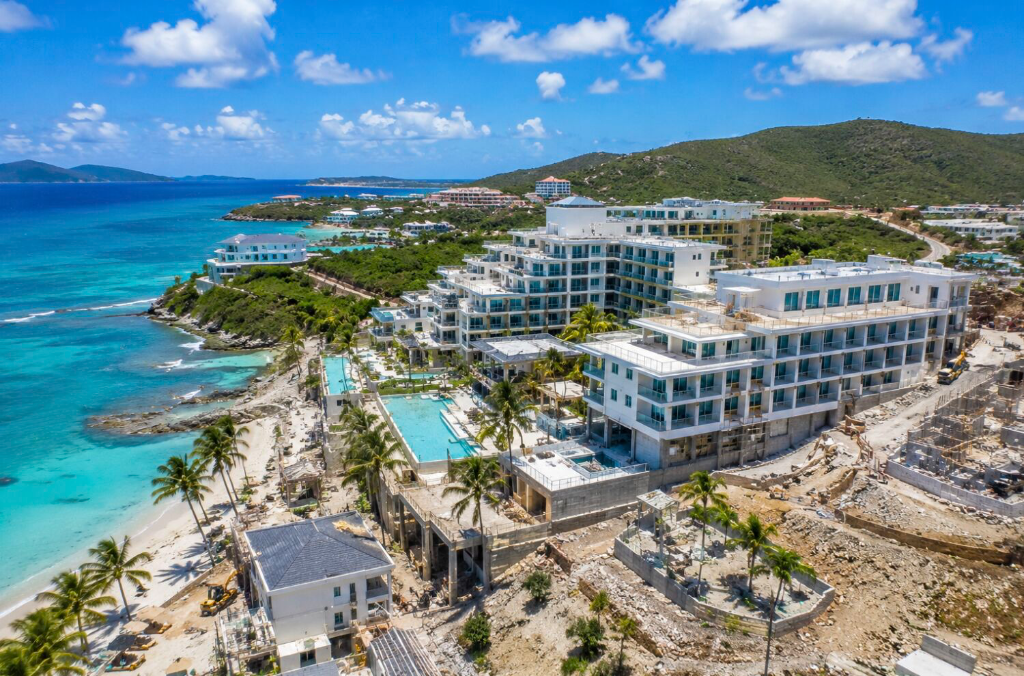
The Caribbean's Next Construction Era
Where Luxury, Resilience, and the Building Envelope Meet
Market Report · July 2026
Across the Caribbean, a new construction story is unfolding.
It can be seen in the rise of branded residences, private resort communities, marina-front estates, wellness campuses, luxury villas, boutique hotels, and high-end mixed-use developments being planned and built across some of the region's most desirable islands.
For decades, the Caribbean was viewed primarily as an escape — a place for seasonal travel, beach vacations, second homes, and resort getaways. But today, the region is moving into a more sophisticated phase of development. It is no longer just about tourism. It is about long-term ownership, branded lifestyle living, wealth migration, hospitality investment, and resilient coastal construction.
The broader Caribbean residential real estate market has been reported at an estimated $1.87 trillion, with continued growth projected in the years ahead. Whether viewed through the lens of real estate, tourism, hospitality, or private wealth, one thing is clear: the Caribbean is no longer a quiet secondary market. It is becoming one of the most closely watched luxury development regions in the world.
This is not simply another real estate cycle.
It is a structural transformation.
The region's momentum is being fueled by several powerful forces at once. Tourism has remained resilient, with the Caribbean Tourism Organization reporting that international stay-over arrivals reached an estimated 35 million visits in 2025. Global hospitality brands continue to expand. Private wealth is seeking lifestyle-driven destinations. Remote work and second-home ownership have changed how affluent buyers think about island living. At the same time, developers are looking beyond traditional hotel models and moving toward branded residences, resort communities, private clubs, and wellness-centered real estate.
The Growth of Branded Residences
Globally, branded residential development has become one of the most powerful trends in luxury real estate. Savills reported that the number of branded residence schemes was expected to rise from 764 in December 2024 to 910 by the end of 2025. This trend is now clearly visible across the Caribbean, where buyers are increasingly drawn to properties connected to trusted hospitality names, managed services, wellness amenities, security, privacy, and long-term asset value.
Brands such as Four Seasons, Ritz-Carlton, Rosewood, Aman, Mandarin Oriental, Auberge, Six Senses, and other luxury hospitality groups are helping reshape expectations across the islands. Four Seasons now promotes a Caribbean collection that includes Nevis, Anguilla, The Ocean Club in the Bahamas, and Puerto Rico. Other high-end resort and residential projects are also moving through the pipeline across destinations such as the Bahamas, Turks and Caicos, Puerto Rico, the Dominican Republic, Barbuda, and beyond.
But the arrival of these brands brings more than prestige.
It raises the standard.
Ultra-high-net-worth buyers entering these communities are not only purchasing ocean views, beach access, privacy, and lifestyle. They are purchasing confidence. They expect the property to perform. They expect the residence to be built to a global standard. They expect the materials to last. They expect serviceability, durability, insurance readiness, and protection against the realities of coastal living.
In the Caribbean, beauty alone is no longer enough.
The region offers some of the most breathtaking development sites in the world, but many of those sites also come with some of the most demanding environmental conditions. Coastal winds, hurricane exposure, salt air, intense sun, humidity, water intrusion, corrosion, and shifting insurance requirements all place extraordinary pressure on a building.
That is why the building envelope has become one of the most important parts of the Caribbean construction story.
Windows, doors, glazing systems, framing, seals, hardware, installation methods, and maintenance planning are no longer secondary design details. They are central to the performance, protection, and long-term value of the property.
In many luxury projects, fenestration is still treated too late in the process. It is often viewed as a design selection, chosen after the architectural vision has already been shaped. But in high-exposure island environments, that approach can create risk.
The window and door package should not be treated as an afterthought.
It should be part of the risk strategy from day one.
In the Caribbean, windows and doors are not just architectural features. They are the first line of defense against wind, water, salt, heat, humidity, and time. A beautiful system that is not properly rated, documented, installed, or maintained can become one of the most expensive vulnerabilities in the entire project.
Modern Caribbean construction increasingly requires institutional-grade standards, including:
- Hurricane-rated impact glazing
- Thermal-break framing systems
- Marine-grade hardware
- Corrosion-resistant finishes
- Proper water management
- Verified testing and approvals
- Strong installation methods
- Clear maintenance protocols
- Documented product performance
- Long-term serviceability in coastal conditions
These are quickly becoming baseline expectations, not optional upgrades.
The shift is especially important in luxury and branded residential development, where the buyer profile has changed. Today's high-end Caribbean buyer is often highly informed. They may own homes in Miami, Palm Beach, New York, London, Dubai, Monaco, or the Hamptons. They understand quality. They ask better questions. They expect documentation. They want to know whether the property can withstand the conditions of the island, not just photograph well for a brochure.
That changes the role of every product selected for the project.
A window is no longer just a window.
A door is no longer just a door.
A glazing system is no longer just part of the view.
Together, they become part of the property's protection, comfort, energy performance, maintenance profile, insurance story, and resale value.
This is where many Caribbean projects face a hidden challenge. The region is not one single market. Each island has its own approval process, import realities, construction culture, labor conditions, climate exposure, and logistical limitations. What works in South Florida may not automatically work in the Bahamas. What works in Europe may not be suitable for Turks and Caicos. What looks impressive in a showroom may not perform the same way after years of salt-air exposure on an oceanfront site.
Why Regional Expertise Matters
The Caribbean requires more than beautiful products. It requires knowledge of climate, codes, approvals, installation, corrosion, maintenance, transportation, and local conditions. Developers need to know whether a system is truly appropriate for the island, whether the documentation supports the project, whether the installer understands the product, and whether the manufacturer can support the asset long after delivery.
Because in high-end coastal construction, the cost of getting it wrong is not small.
- The wrong system can affect approvals.
- It can delay timelines.
- It can create insurance issues.
- It can lead to water intrusion.
- It can increase maintenance costs.
- It can damage the developer's reputation.
- It can reduce buyer confidence.
- It can weaken resale value.
In a market where global brands are entering, buyers are more sophisticated, and construction costs are rising, product mistakes become more visible and more expensive.
There is also a larger issue at play: resilience.
The Caribbean has always lived with weather risk, but the new development cycle is forcing a more serious conversation about how luxury properties are built, protected, and maintained. Recent storms, recovery efforts, and resort reopenings have reminded the market that resilience is not theoretical. It is operational. It affects business interruption, guest confidence, owner satisfaction, insurance, financing, and long-term asset performance.
A luxury property may sell because of the view.
But it survives because of the details.
- The strength of the glass.
- The quality of the frame.
- The drainage design.
- The hardware finish.
- The installation method.
- The maintenance plan.
- The documentation behind the product.
- The integrity of the people who specified, supplied, and installed it.
This is the part of the construction story that does not always make the headline, but it determines how the building performs after the ribbon cutting.
The Caribbean is entering a new era where trust will matter as much as design. Developers, architects, builders, investors, and buyers will increasingly need proof — proof of performance, proof of product integrity, proof of installation quality, proof of compliance, and proof that the systems selected can handle the environment they are being placed in.
The next wave of Caribbean construction will not only be judged by how beautiful it looks on opening day.
It will be judged by how it performs five, ten, and twenty years later.
That is the real story behind the region's construction wave.
The capital is moving.
The brands are arriving.
The buyers are more sophisticated.
The terrain is more demanding.
The climate is unforgiving.
And the standards have never been higher.
For developers and investors entering the Caribbean, the question is no longer simply:
What looks beautiful?
The better question is:
Will it perform when the island tests it?
Because in this next chapter of Caribbean construction, luxury will not be defined by appearance alone.
It will be defined by resilience.
And trust will not be built on promises.
It will be built on proof.